
There is a question we heard repeatedly in conversations with network engineers:
"We have all the data. Why does it still take hours to understand what's happening?"
It is a good question. And it is the reason we built KNAP.
Mobile networks today generate more data than ever before — performance counters, alarms, call traces, configuration parameters, geolocation signals, topology maps.
The data exists. The problem is what happens next.
It gets distributed across separate OSS systems, accessed through different tools, and interpreted manually by engineers who spend their days jumping between dashboards, correlating information by hand, and making decisions under time pressure.
The bottleneck was never the data.
It was the distance between the data and the decision.
Built around a different assumption
Most telecom tools are built around a use-case logic: one tool for interference, one for congestion, one for performance analysis.
Each does its job. None of them talk to each other. And none of them are designed to act: they are designed to show.
We started from a different assumption.
If you unify the data first, and apply intelligence on top of it, you do not need engineers to manually connect the dots. You need agents that do it for them.
KNAP is built around three layers, each with a distinct role:
- Telco Fabric — the data layer. It unifies all network data sources into a single coherent model. Decode once, use everywhere.
- AI/ML algorithms — the understanding layer. Telco-specific algorithms detect anomalies, classify issues, and predict congestion on top of unified data.
- AI Agents — the action layer. Agents receive the representations generated by the layers below, make operational decisions, and execute them.
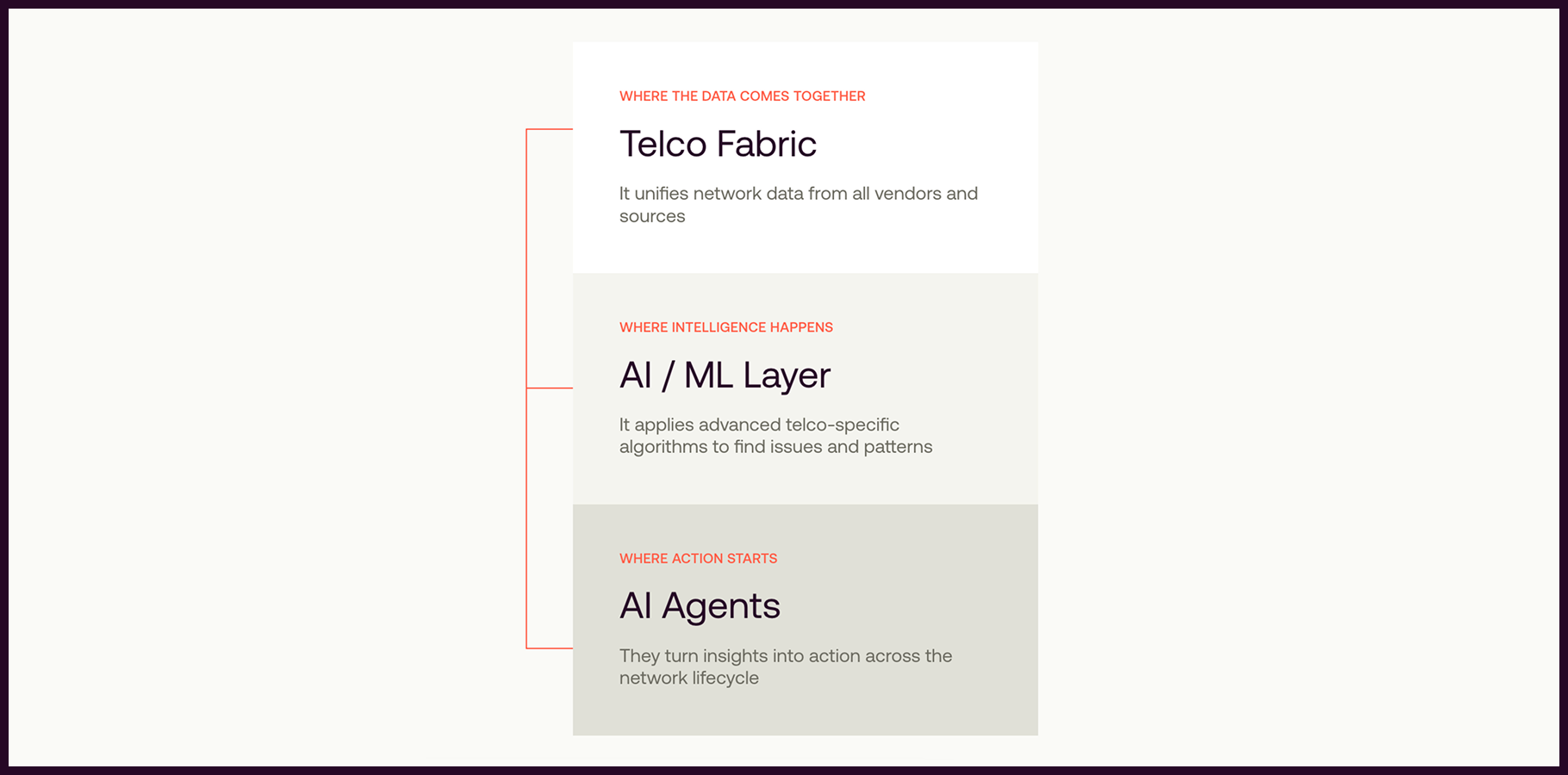
The principle is simple: decode the data once, use it everywhere.
Let the agents do the analysis. Keep the engineers focused on decisions that actually require human judgment.
What an agent actually does
Agents sit on top of the existing data and analytics stack. They consume its outputs and turn them into bounded operational decisions and actions.
KNAP's agents are goal-oriented software entities, each designed for a specific operational task.
- A Performance Analysis Agent detects and interprets performance deviations, then initiates the appropriate response.
- A Troubleshooting Agent identifies root causes and drives remediation from diagnosis to resolution.
- A Network Expansion Agent translates traffic and capacity signals into planning actions.
- A Customer Complaint Agent connects service complaints to specific network events and owns the follow-up.
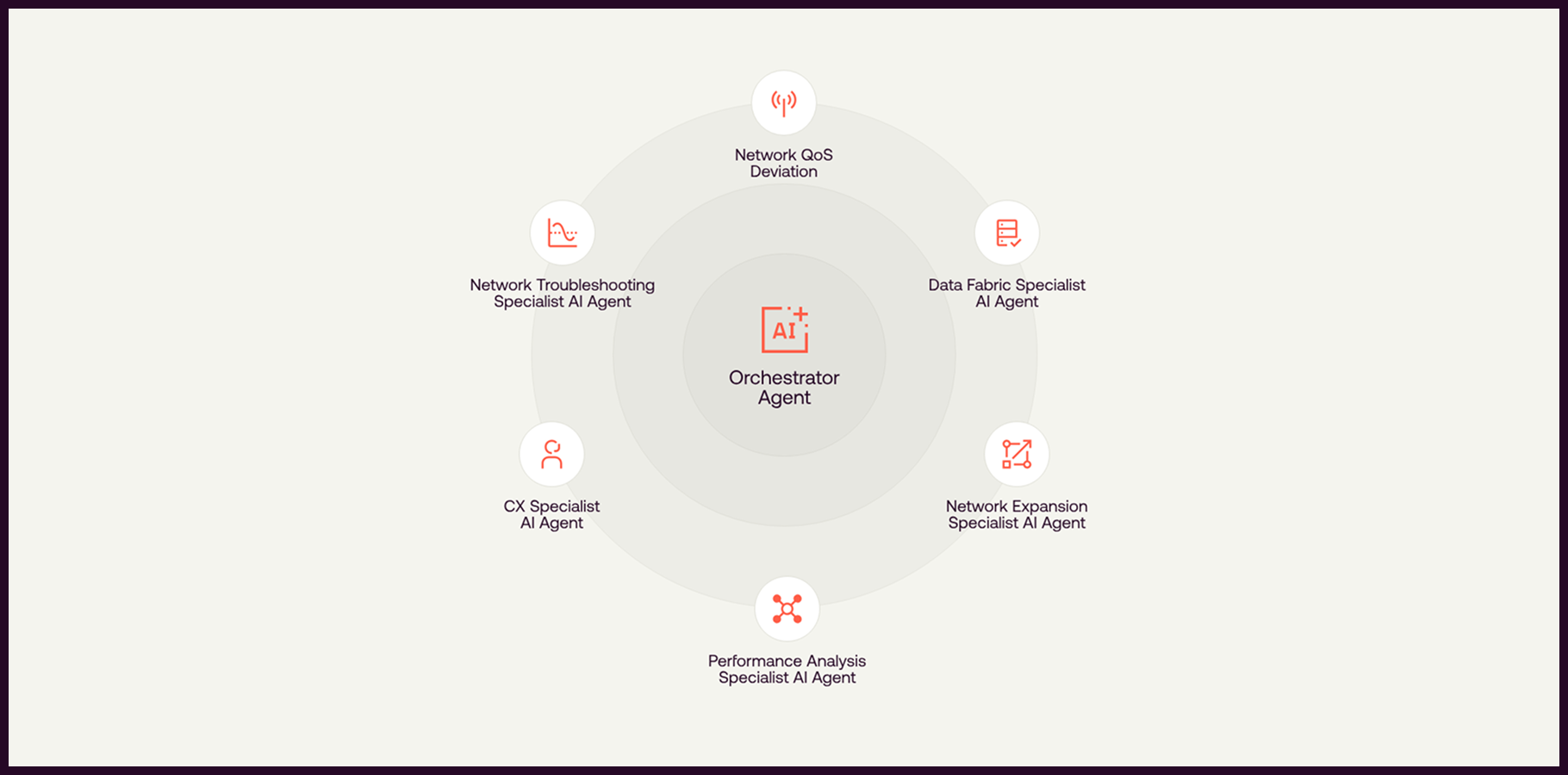
And so on.
Each agent operates within boundaries defined by the operator.
They do not act as a black box — every action is traceable, every decision boundary is configurable, and the network team retains full visibility and override capability at any time.
When multiple agents coordinate through the Orchestrator, entire operational workflows can run autonomously: detect an anomaly, analyze the relevant data, identify the root cause, generate a recommendation...
What previously required hours of manual work can happen in seconds.
Where this is going
KNAP is not a finished product in the sense that its scope is fixed.
It’s a platform designed to evolve alongside the networks it serves. The long-term direction is clear: networks that can monitor, diagnose and optimize themselves, with minimal human intervention.
We are not there yet, and we are not claiming to be.
But the path is defined — from analytics, to automated analysis, to decision support, to autonomous operations.
KNAP is the infrastructure for that journey.
We built it because the tools that exist were not designed for this future. They were designed for the present, which is already becoming the past.
--
Want to learn more about KNAP? Get in touch.